
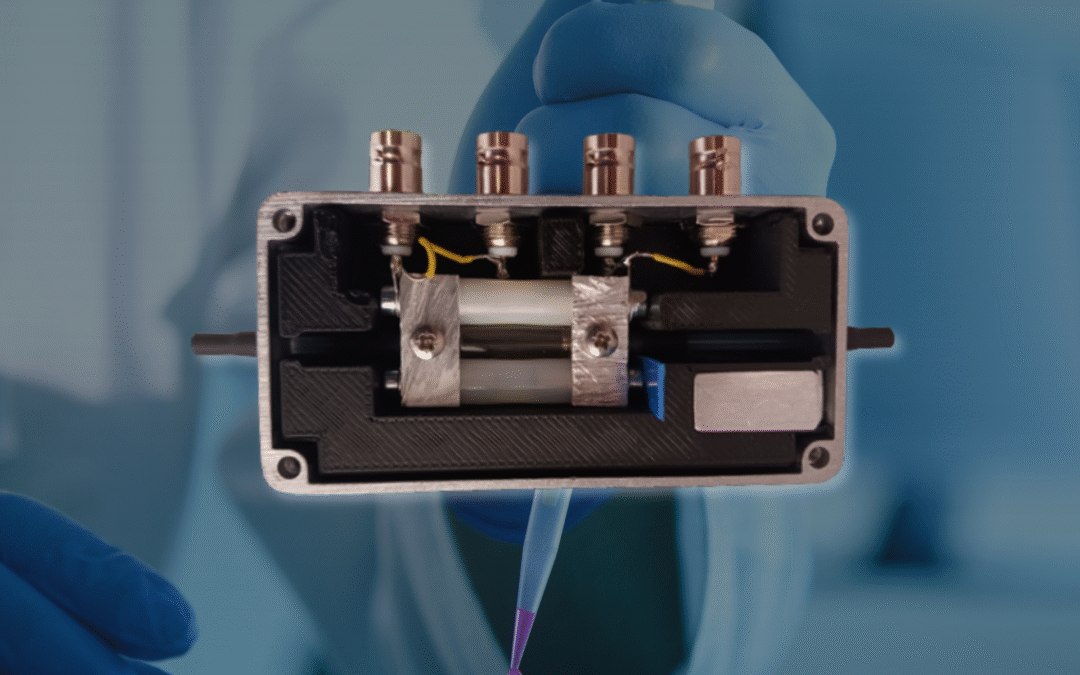
With the growing use of microfluidic systems, lab-on-a-chip devices, and miniature sensors, calibration techniques that can handle very small liquid volumes – such as conductivity calibration – are becoming increasingly important. Accurate calibration of small volumes is particularly crucial when only limited quantities of sample or certified reference material (CRM) are available, and when the calibration process must closely reflect the actual sample volumes used in analytical instruments.
DFM has extensive experience in electrolytic conductivity measurements and in providing certified reference materials for conductivity. Building on this foundation, we have developed a new calibration method designed specifically for small-volume-scale applications. This new approach is based on a tube design that enables precise and stable conductivity measurements in very small sample volumes.
One of the main challenges in small-volume conductivity calibration is the handling of salt particles and the establishment of a uniform and stable electric field in a flowing liquid. DFM has addressed these challenges by developing a novel construction consisting of two conductive stainless-steel tubes, each with an inner diameter of 2.1 mm and positioned 5.7 mm apart. This configuration provides an effective cell volume of approximately 20 µL while maintaining excellent field stability and reproducibility.
Our results demonstrate that this method enables reliable conductivity measurements in sample volumes smaller than 10 mL across a wide conductivity range from 10 mS/m to 20 S/m. Remarkably, the method achieves the same level of expanded uncertainty as obtained in calibration of electrolytic conductivity sensors which requires much larger volumes.
This innovation bridges an important gap in microscale metrology and supports the increasing demand for high-precision measurements in biotechnology, pharmaceutical research, and microfluidic device development. It represents a significant step forward in ensuring measurement traceability and accuracy in emerging small-scale analytical systems.